Abrasion Resistance
E5 Internal Cure increases surface abrasion resistance by an average of 70% across all cement types and brands — upgrading concrete from light-duty to heavy-duty wear classification. Adding E5 Catalyst achieves very heavy-duty classification with up to 87% improvement. E5 densifies the concrete surface through particle packing, controls water within the matrix as a hydration booster, and increases nucleation sites to produce more C-S-H.
The Challenge
Concrete surface abrasion is a durability issue caused by exposure to friction or impact from solid particles. Without proper curing, concrete develops a weak microstructure that wears under traffic — from rubber tyres and foot traffic through to steel tyres, heavy impact, and dragged loads. Testing across multiple cement types (Type 1 and Type 1L) and brands shows that without E5, all concrete falls into the light-duty wear classification — unsuitable for warehouse, industrial, or heavy-traffic applications. Type 1L cements perform 17–27% worse than Type 1 for abrasion resistance, compounding the problem as the industry moves toward lower-carbon blended cements.
Our Approach
E5 Internal Cure densifies the concrete surface through three mechanisms: (i) particle packing at the nano level, (ii) controlling water within the concrete matrix as a hydration booster, and (iii) increasing the number of nucleation sites — enhancing cement hydration to produce more calcium silicate hydrate (C-S-H). Independent testing across six cement types from four manufacturers shows E5 Internal Cure increases abrasion resistance by an average of 70% (range 65–73%), upgrading every cement tested from light-duty to heavy-duty classification. Adding E5 Catalyst further improves performance to very heavy-duty classification — up to 87% improvement — approaching the special classification required for very heavy-duty factories with loaded steel tyres.
Key Benefits
How It Works
E5 Internal Cure is added to the concrete mix — nano-silica particles densify the surface through particle packing and increase nucleation sites
E5 controls water within the concrete matrix, acting as a hydration booster to ensure complete cement hydration
Enhanced hydration produces more C-S-H (calcium silicate hydrate), creating a harder, denser surface microstructure
For maximum abrasion resistance, E5 Catalyst is spray-applied during finishing — creating extreme surface hardness
The result: concrete that meets heavy-duty or very heavy-duty wear classifications without surface hardeners, coatings, or overlays
Surface Abrasion Wear Classifications
Industry standard classifications for concrete floor abrasion resistance
| Classification | Wear Resistance | Max Depth | Typical Use | Traffic Type |
|---|---|---|---|---|
| Special | Extremely High | 0.050 mm | Very Heavy-Duty Factories | Heavy Loaded Steel Tyres, High Impact, Dragged Loads |
| AR1 | Very High | 0.100 mm | Heavy-Duty Factories and Warehouses | Steel Tyres, Impact |
| AR2 | High | 0.200 mm | Medium-Duty Factories and Warehouses | Lightly Loaded Steel Tyres, Hard Plastic Tyres |
| AR3 | Good | 0.400 mm | Light-Duty Factories and Warehouses | Rubber Tyres |
Surface Abrasion Test Results
Independent testing across 4 cement manufacturers, 6 cement types — with and without E5
| Brand | Mix | Depth (mm) | Classification | Wear Depth |
|---|---|---|---|---|
| Buzzi | Buzzi Type 1 | 0.210 | Medium Duty | |
| Buzzi Type 1 / E5 IC | 0.064 | Heavy Duty | ||
| Buzzi 1L | 0.295 | Light Duty | ||
| Buzzi 1L / E5 IC | 0.080 | Heavy Duty | ||
| Buzzi 1L / E5 IC / E5 Catalyst + Catalyst | 0.039 | Very Heavy Duty | ||
| Lehigh | Lehigh Type 1 | 0.228 | Medium Duty | |
| Lehigh Type 1 / E5 IC | 0.076 | Heavy Duty | ||
| Lafarge | Lafarge Type 1 | 0.274 | Light Duty | |
| Lafarge Type 1 / E5 IC | 0.096 | Heavy Duty | ||
| Lafarge 1L | 0.331 | Light Duty | ||
| Lafarge 1L / E5 IC | 0.106 | Heavy Duty | ||
| Lafarge 1L / E5 IC / E5 Catalyst + Catalyst | 0.046 | Very Heavy Duty | ||
| ECO CEM | ECO CEM 1L | 0.285 | Light Duty | |
| ECO CEM / E5 IC | 0.080 | Heavy Duty | ||
| ECO CEM / E5 IC / E5 Catalyst + Catalyst | 0.046 | Very Heavy Duty |
Improvement Summary by Cement Brand
Buzzi
- Type 1 + E5 IC: 70% improvement
- Type 1L + E5 IC: 73% improvement
- Type 1L + E5 IC + Catalyst: 87% improvement
Lehigh
- Type 1 + E5 IC: 66% improvement
Lafarge
- Type 1 + E5 IC: 65% improvement
- Type 1L + E5 IC: 68% improvement
- Type 1L + E5 IC + Catalyst: 86% improvement
ECO CEM
- Type 1L + E5 IC: 69% improvement
- Type 1L + E5 IC + Catalyst: 82% improvement
Conclusion: Adding E5 Nano Silica to concrete — across ALL cement types and brands — increases surface abrasion resistance by an average of 70% (range 65–87%). With all cement types and brands, incorporating E5 for internal curing substantially increases concrete durability by reducing surface abrasion.
How E5 Improves Abrasion Resistance
Particle Packing
Nano-silica particles densify the concrete surface by filling voids at the nano level — creating a tighter, more wear-resistant microstructure.
Hydration Booster
E5 controls water within the concrete matrix, ensuring it is consumed by cement hydration rather than lost — producing a harder, denser surface.
Nucleation Sites
E5 increases nucleation sites, enhancing cement chemical reactivity during hydration — producing more C-S-H (calcium silicate hydrate), the binder that gives concrete its strength.
Case Studies
Real-world abrasion resistance projects

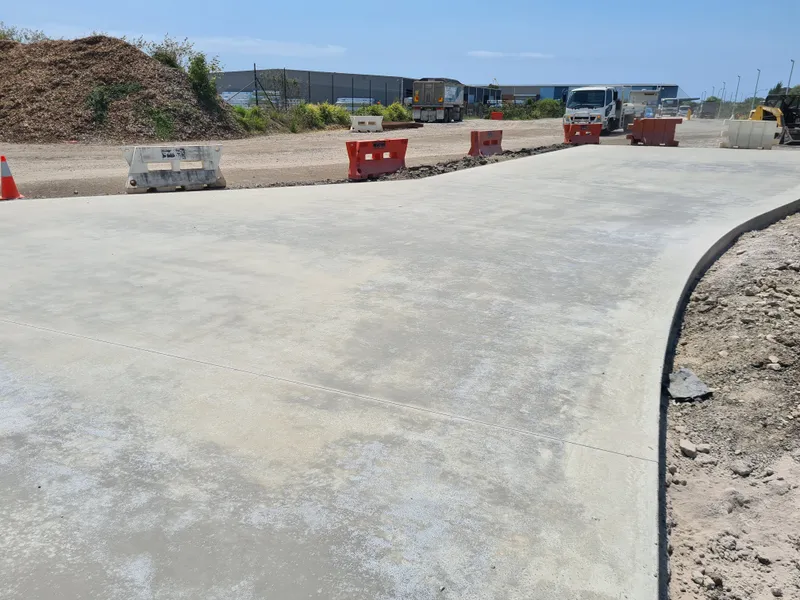
Rawcon — Heavy Traffic Slabs
— Sunshine Coast, QLD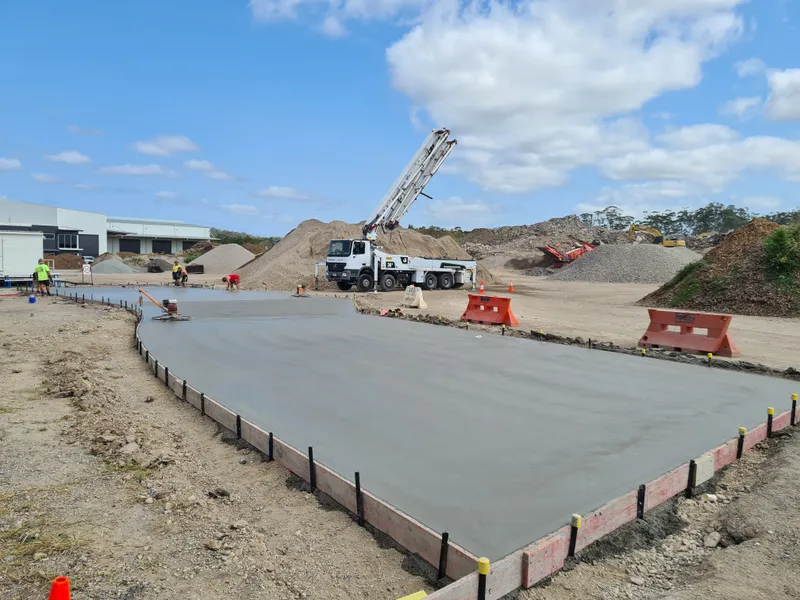
Ideal For
- Warehouse and distribution centre floors (heavy-duty classification)
- Manufacturing and processing plants with forklift and steel-tyre traffic
- Aircraft hangars and maintenance facilities
- High-traffic retail and commercial spaces
- Projects using Type 1L (blended) cements where abrasion resistance is critical
- Any concrete floor requiring long-term abrasion durability without topical treatments
Services We Provide
- Abrasion resistance specification and wear classification design
- Mix design optimisation for target wear classification
- On-site finishing training for E5 Catalyst application
- Surface abrasion testing and compliance verification